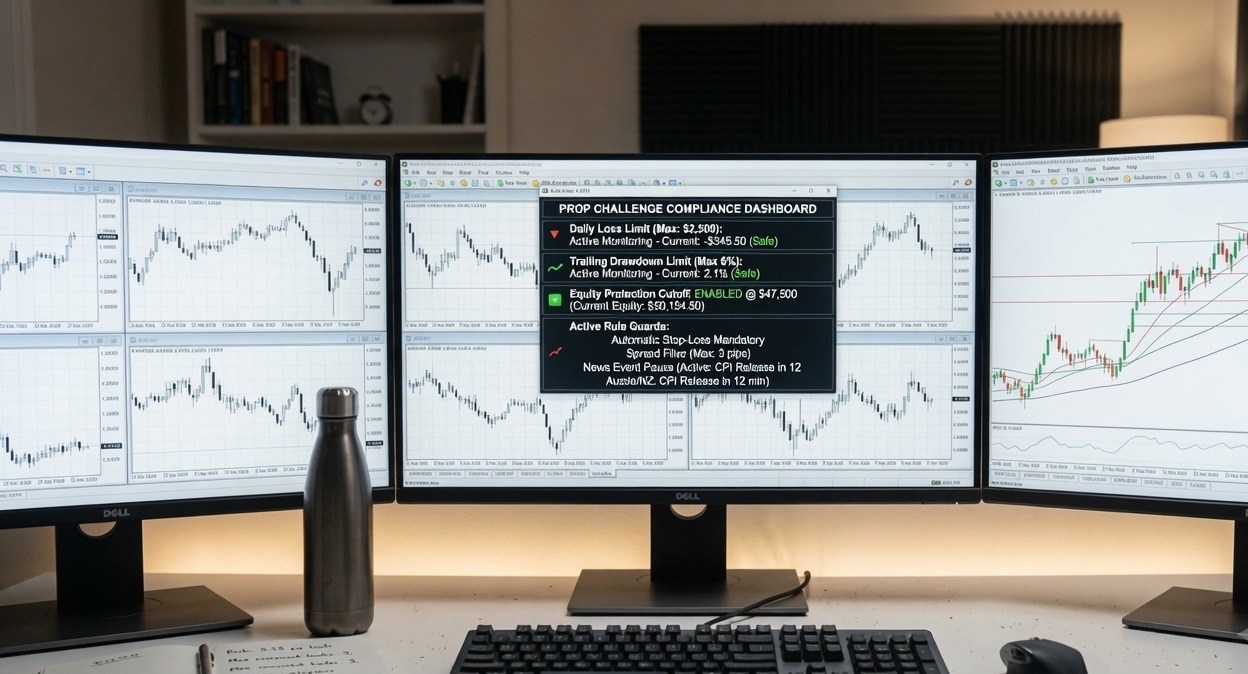
Proprietary (prop) trading firms give traders access to significantly larger trading capital after they successfully complete an evaluation or challenge. These opportunities allow skilled traders to scale their strategies without risking substantial personal funds. However, passing a prop firm challenge is rarely about generating the highest returns—it is about consistently following strict risk management rules.
Many traders fail evaluations not because their strategy lacks profitability, but because they violate one or more of the firm’s trading rules. This is where algorithmic trading and Expert Advisors (EAs) can provide a significant advantage. By automating decision-making and risk controls, traders can execute their strategy consistently while reducing emotional mistakes.
Understanding Prop Firm Rules
Every proprietary trading firm runs its own evaluation, but most challenges circle the same handful of guardrails. There’s almost always a hard daily loss limit and a separate cap on total drawdown — breach either one and the account is usually done, regardless of how the rest of the month went. Layered on top are the more routine requirements: a profit target to hit, a minimum number of trading days so nobody gets there on a single lucky trade, and position-size limits that keep any one bet from being the whole game. Some firms add extras — restrictions around trading major news releases, or rules against holding positions over the weekend — but the core few show up almost everywhere. Even a genuinely profitable strategy can fail the evaluation if it trips just one of these, which is why success depends more on discipline than on raw returns.
Why Algorithmic Trading Works Well for Prop Firm Challenges
Manual trading often introduces emotional decisions during winning and losing streaks. Traders may increase lot sizes after losses, close profitable trades too early, or ignore predefined limits in an attempt to recover quickly.
Algorithmic trading removes much of this emotional influence by executing predefined rules automatically.
Key advantages include:
- Consistent trade execution
- Automated risk management
- Reduced emotional decision-making
- Faster reaction to market conditions
- Improved trading discipline
- Precise adherence to predefined trading rules
Because every decision follows programmed logic, an EA helps maintain consistency throughout the evaluation period.
Essential Risk Controls to Pass Any Prop Firm Challenge
A well-designed Expert Advisor should do far more than simply generate trade entries. It should actively protect the account from violating challenge rules.
Important risk management features include:
- Daily loss monitoring
- Maximum drawdown protection
- Position size limits
- Automatic Stop Loss placement
- Trade frequency controls
- Maximum simultaneous trades
- Daily trading pause after reaching predefined loss limits
- Spread and volatility filters during unstable market conditions
These safeguards help ensure trading activity remains within the firm’s permitted risk parameters while preserving long-term consistency.
Backtesting and Strategy Validation

Before deploying an EA on a prop firm challenge account, comprehensive testing is essential.
A structured validation process should include:
- Backtesting across different market conditions
- Testing multiple currency pairs or instruments
- Forward testing on a demo account
- Verifying compliance with all challenge rules
- Measuring maximum drawdown alongside profitability
- Monitoring execution quality, slippage, and spread variations
While backtesting helps evaluate historical performance, forward testing demonstrates how the strategy behaves in live market conditions where execution delays and changing spreads become important factors.
Common Mistakes That Cause Challenge Failures
Many traders fail prop firm challenges because of avoidable mistakes rather than poor trading strategies.
Common errors include:
- Chasing profit targets with excessive risk
- Ignoring daily drawdown limits
- Over-optimizing strategies using historical data
- Increasing lot sizes after losing trades
- Removing Stop Losses during open positions
- Trading during highly volatile news events without proper filters
- Failing to adapt to changing market conditions
Passing a prop firm challenge is generally about protecting capital first and generating profits second. A disciplined, rules-based approach often produces more consistent long-term results than attempting to achieve rapid gains.
Building a Prop Firm-Compliant Expert Advisor
If you’re developing a custom EA specifically for prop firm challenge trading, consider implementing features that support both performance and compliance.
Examples include:
- Configurable daily loss limits
- Dynamic lot sizing based on account risk
- Automatic trading suspension after rule violations
- Time and session filters
- News event filters
- Equity protection mechanisms
- Detailed performance logging and reporting
These capabilities make it easier to adapt the EA to different proprietary trading firms, each of which may have unique evaluation requirements.
Conclusion
Passing a prop firm challenge isn’t really a strategy problem — most rejected traders had a strategy that could have worked. It’s a compliance problem: a daily drawdown breached by one bad Tuesday, a lot size that crept up after two losses, a stop loss removed “just this once.” Algorithmic execution closes that gap. An EA doesn’t get impatient in week two or try to recover a red day by doubling down; it enforces the same daily loss cap, the same lot size, the same news filter on day 30 that it did on day one.
That said, no EA guarantees a pass — a poorly backtested or over-optimized strategy will fail the evaluation just as fast with or without automation. The traders who consistently clear these challenges pair a validated strategy with hard-coded risk limits, then let discipline do the rest.
Need a Custom EA for Prop Firm Challenges?
Build a tailored MQL4/MQL5 Expert Advisor with built-in daily drawdown controls, news filters, and automatic risk management tailored to pass your challenge.
Contact Us →