
Machine learning is transforming algorithmic trading by enabling traders to analyze large datasets, identify patterns, and make data-driven decisions. While MetaTrader (MT4/MT5) is a powerful platform for executing trades, Python offers one of the richest ecosystems for machine learning and data analysis.
By connecting MetaTrader with Python, traders can build intelligent trading systems that combine advanced analytics with automated trade execution.
Why Use Python with MetaTrader?
Python has become the preferred programming language for data science and artificial intelligence due to its extensive collection of powerful libraries.
Some of the most commonly used libraries include:
- Pandas – Data analysis and manipulation
- NumPy – High-performance numerical computing
- Scikit-learn – Traditional machine learning algorithms
- TensorFlow & PyTorch – Deep learning and neural networks
- Matplotlib – Data visualization and charting
By integrating Python with MetaTrader, traders can:
- Build predictive trading models
- Analyze market sentiment
- Detect AI-driven trading signals
- Automate strategy testing
- Execute trades automatically
- Process large amounts of historical market data
Methods to Connect MetaTrader and Python
There are several ways to integrate MetaTrader with Python, depending on your platform and project requirements.
1. MetaTrader 5 Python API
MetaTrader 5 provides an official Python package that allows direct communication between Python scripts and the MT5 terminal.
Using the MT5 Python API, developers can:
- Retrieve historical and live market data
- Access account information
- Place market and pending orders
- Modify existing trades
- Monitor open positions
This is the simplest and most reliable integration method for MT5 users.
2. File-Based Communication
Another common approach is exchanging information through files.
In this method:
- An Expert Advisor exports market data to CSV or text files.
- Python processes the data and generates trading signals.
- The signals are written back to another file.
- The Expert Advisor reads the signal file and executes trades.
Although slower than direct communication, this file-exchange method is a simple way to connect MetaTrader with Python on both MT4 and MT5.
3. Socket or API Communication
For applications requiring real-time performance, Metatrader with Python can communicate through:
- TCP/IP sockets
- REST APIs
- WebSockets
This approach provides faster data exchange and is ideal for AI models running outside the trading terminal.
Typical Machine Learning Trading Workflow
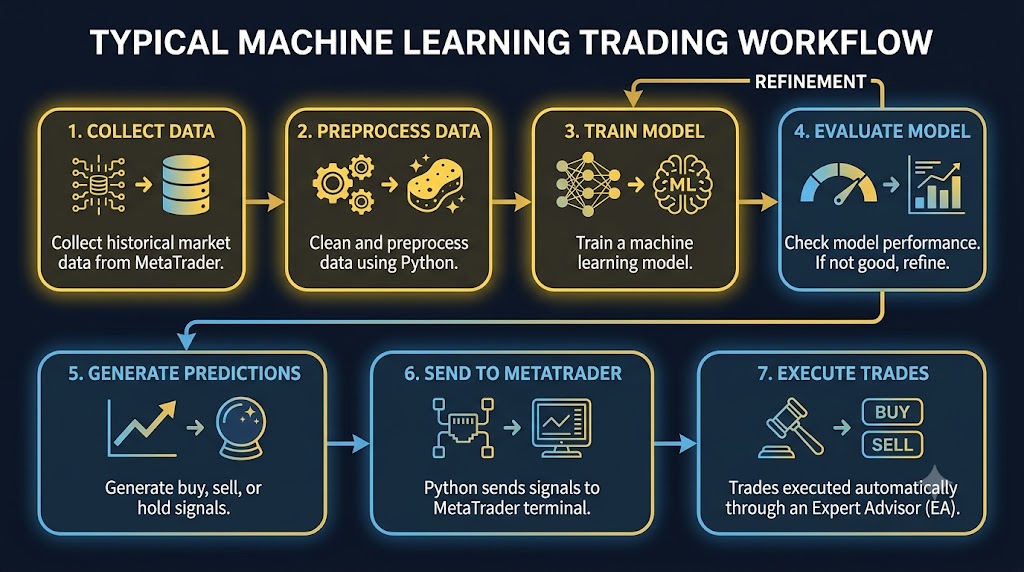
A typical AI-powered trading system follows these steps:
1.Collect Data: Gather historical market data directly from MetaTrader.
2.Preprocess: Clean and analyze the data using Python.
3.Train Model: Train the machine learning model.
4.Evaluate Performance: Validate the model; if the performance is not satisfactory, refine the model.
5.Generate Predictions: Use the trained model to generate Buy, Sell, or Hold signals.
6.Send to MetaTrader: The Python script transmits these signals back to the MetaTrader terminal.
7.Execute Trades:An Expert Advisor (EA) reads the incoming signals and automatically executes the trades.
This workflow combines Python’s analytical capabilities with MetaTrader’s automated execution engine.
Best Practices
When integrating MetaTrader with Python, consider the following recommendations:
- Use high-quality historical market data.
- Validate models with out-of-sample testing.
- Apply proper risk management techniques.
- Monitor model performance continuously.
- Minimize communication latency for time-sensitive strategies.
- Maintain detailed logs for troubleshooting and performance analysis.
Common Challenges
Despite its advantages, Metatrader with Python integration introduces several technical challenges.
Common issues include:
- Data synchronization between MetaTrader and Python
- Communication latency
- Machine learning model overfitting
- Trade execution errors
- Efficient handling of large datasets
Implementing robust error handling, logging, and monitoring helps ensure reliable operation in live trading environments.
Conclusion
Connecting MetaTrader with Python unlocks powerful opportunities for AI-driven algorithmic trading. By combining Python’s machine learning ecosystem with MetaTrader’s automated trading capabilities, traders can develop more intelligent strategies, improve market analysis, and automate decision-making.
Whether you’re building predictive models, developing quantitative trading systems, or experimenting with artificial intelligence, integrating Metatrader with Python provides a flexible and scalable foundation for modern algorithmic trading.
Key Takeaways
- Python adds powerful machine learning and data analysis capabilities to MetaTrader.
- MT5 offers an official Python API for direct integration.
- MT4 and MT5 can also communicate with Python through files or network-based APIs.
- AI trading systems typically follow a workflow of data collection, model training, signal generation, and automated execution.
- Proper testing, risk management, and monitoring are essential for reliable live trading.
Need a Custom MetaTrader–Python Integration?
Whether you need an MT5 Python API solution, MT4/MT5 Expert Advisor, socket-based communication, or a complete AI-powered trading system, MQLCoder develops custom algorithmic trading solutions tailored to your trading strategy.
Explore our services: https://mqlcoder.com/services